Marking Attribution
What is marketing attribution?
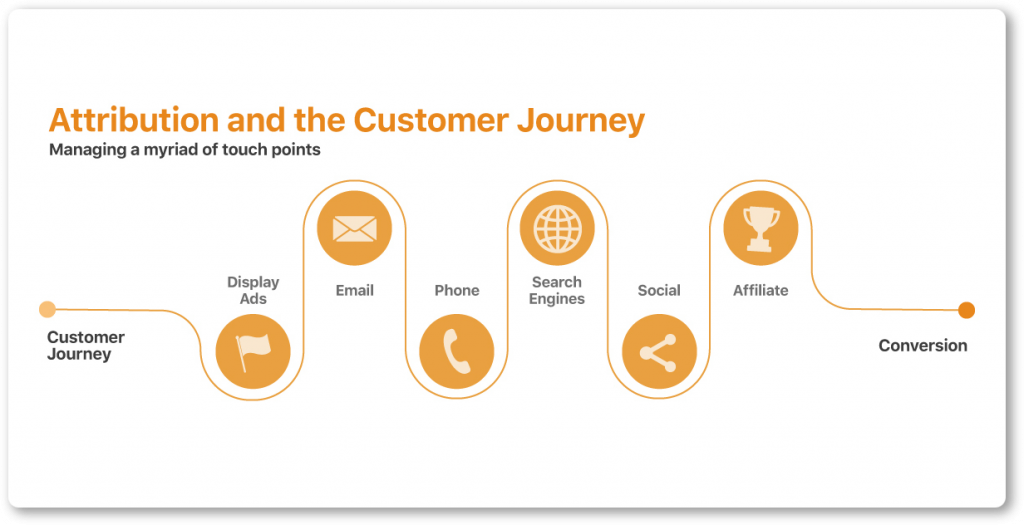
Marketing attribution is the way advertisers determine how marketing tactics – and subsequent customer interactions – contributed to sales, conversions or other goals.
i.e. how marketing platforms assign themselves conversion credit.
Marketing tactics and corresponding customer touchpoints can range from social media channels to emails to paid search – and every digital marketing interaction in between. Using these models can be as simple as analyzing one touch point and as complex as considering the intersections of multiple touch points across the path to purchase. Either way, marketing funnel and customer journey modelling are incredibly important to return on investment (ROI), future strategy planning, and more.
Why is marketing attribution important?
When it comes to marketing, knowledge is power – the more you can learn about your past results, the better you can plan your future tactics. Analyzing your current marketing objectives and taking subsequent marketing actions can create a ripple effect for your brand’s strategy. It helps ensure that every single past interaction is accounted for and considered when making future decisions. With so many marketing touchpoints to consider and an increasingly complex customer journey, it’s crucial that brands take a step back to review where they stand and how they may be able to optimize.
That’s where marketing attribution comes in – it helps automate the evaluation process to ensure that you’re getting the most relevant and accurate metrics and KPIs possible. These learnings will help enable you to make smarter, more efficient updates to your marketing team’s tactics and drive more optimization for your business.
Marketing Attribution Models
| Model | Description |
|---|---|
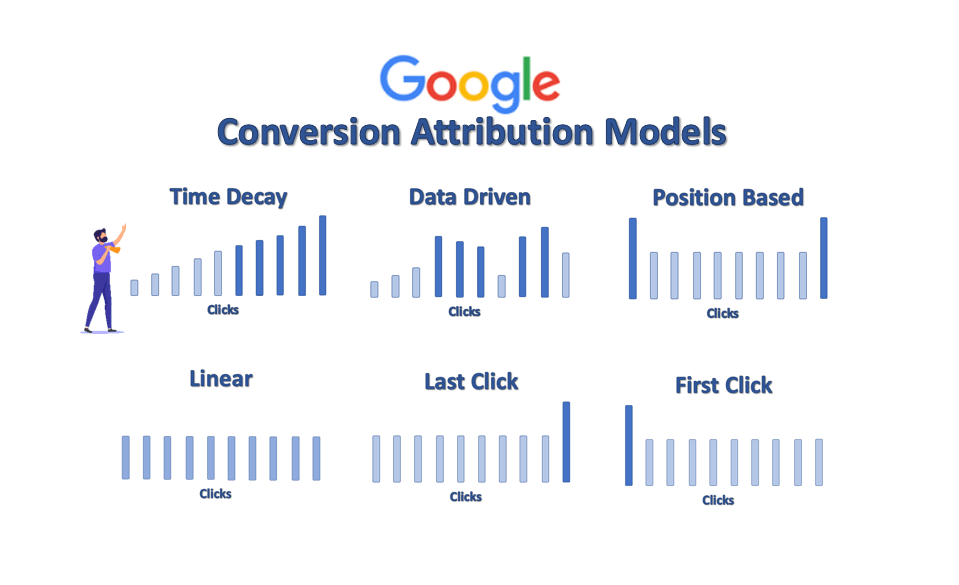
| Last click | Gives all credit for the conversion to the last-clicked ad and corresponding keyword. |
| Data-driven [recommended] | Distributes credit for the conversion based on your past data for this conversion action. It's different from the other models, in that it uses your account's data to calculate the actual contribution of each interaction across the conversion path. The "Data-driven" model is the default attribution model for most conversion actions. Learn more about data-driven attribution |
| First click* | Gives all credit for the conversion to the first-clicked ad and corresponding keyword. |
| Linear* | Distributes the credit for the conversion equally across all ad interactions on the path. |
| Time decay* | Gives more credit to ad interactions that happened closer in time to the conversion. Credit is distributed using a 7-day half-life. In other words, an ad interaction 8 days before a conversion gets half as much credit as an ad interaction 1 day before a conversion. |
| Position-based* | Gives 40% of credit to both the first and last ad interactions and corresponding keywords, with the remaining 20% spread out across the other ad interactions on the path. |
:::note Note
- removed in Google Ads
:::
When to use different attribution models
Compare the different models yourself in Google Ads!
- In your Google Ads account, click the Goals icon .
- Click the Measurements drop down in the section menu.
- Click Attribution.
- In the page menu on the left, click Model comparison.
- Select an option from the "Dimension" drop-down menu.
- Use the "Compare" and "With" drop-down menus to select the attribution models you want to see and compare.
You can search for specific keywords, ad groups, campaigns, or accounts from the search box above the table.
The "Model comparison" report lets you compare two different attribution models side-by-side. To find keywords, ad groups, campaigns, or devices that are undervalued on a last-click basis, you can start with the following comparisons:
Compare the "Last click" model to the "First click" model to identify undervalued keywords that are starting customers down the conversion path. This is particularly valuable if you're looking to drive more new customers to your website. Compare the "Last click" model to the "Linear" model to identify undervalued keywords that are assisting customers all along the conversion path. This is particularly valuable if you want to stay in touch with customers throughout their purchase process. Compare the "Last click" model to the "Data-driven" model to see the value of keywords as determined by Google AI, which looks at how your customers convert to allocate credit. Data-driven attribution also gives you a sense of the value of ad interactions along the entire conversion path.
More information: https://support.google.com/google-ads/answer/6259715?hl=en#attribution_modeling_report